

You know that feeling, anxious for no clear reason, and somehow your stomach’s already in knots before your brain even catches up? Cramping, bloating, that tight pull right under your ribs. It’s not your imagination, and it’s not “just stress”.
Your gut and your brain are wired together, constantly trading signals, and when one struggles, the other usually feels it too. If you’ve done the therapy, tried the meds, downloaded every breathing app, and you’re still stuck, the missing piece might be sitting in your gut.
Here’s what that connection actually looks like, and what you can do about it.
Why Your Anxious Mind Might Actually Be an Anxious Stomach
What Is the Gut-Brain Axis, Exactly?
It’s the two-way line between your digestive system and your brain, and it never hangs up.
Ever notice how you say something’s “gut-wrenching”, or you get “butterflies” before something stressful? That’s not just a figure of speech. Your gut is basically eavesdropping on your emotional state in real time, and reporting straight back.
Your gut runs its own nervous system, tucked right into its walls. Scientists call it the enteric nervous system, nicknamed the “second brain” for good reason. It’s built from roughly 500 million neurons, more than you’ve got in your entire spinal cord. That system talks to your actual brain mostly through the vagus nerve, and most of that traffic runs upward, from gut to brain, not the other way around. Your stomach isn’t just following orders from your head. It’s sending reports, constantly, about inflammation, bacterial balance, and what you ate three hours ago.
This is also why old-school remedies like chamomile tea, a warm bath, or a slow walk after a stressful meal actually do something. They’re not just relaxation tricks. They’re indirect ways of telling your vagus nerve everything’s safe now, and your gut tends to listen.
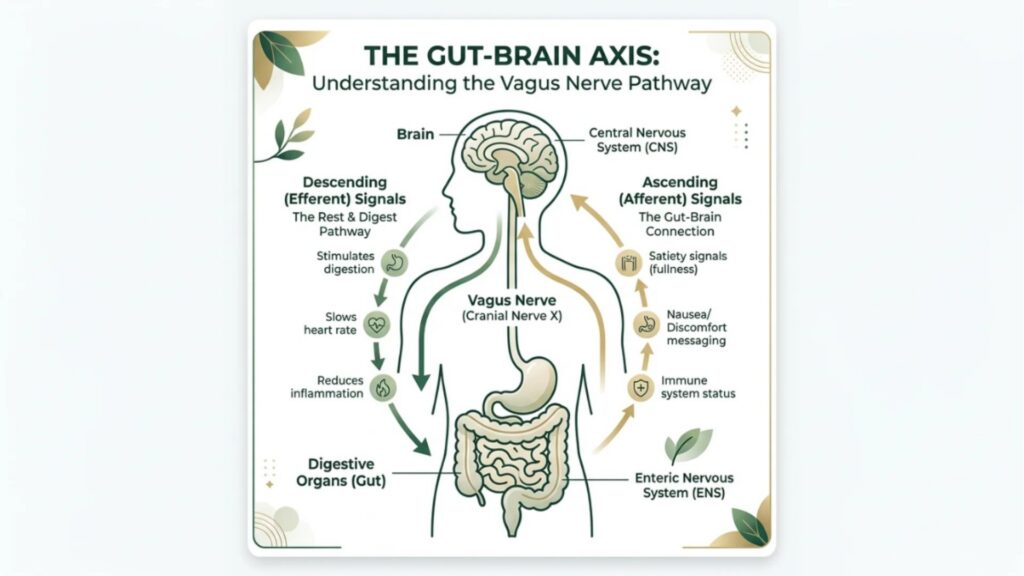
Then there’s the chemistry. A large majority of your body’s serotonin, the neurotransmitter tied to calm and mood stability, gets made in your gut, not your brain. Certain gut bacteria strains produce GABA too, the same calming chemical your brain leans on to put the brakes on anxious thoughts. When that gut environment is inflamed, imbalanced, or depleted, production slows down or goes sideways, and you feel it as anxiety, even when nothing about your actual life has changed.
Here’s where it turns into a loop. Chronic stress raises cortisol. Cortisol, over time, wears down your gut lining, making it more permeable, what a lot of practitioners call a “leaky gut”. Once that lining loosens up, bacterial byproducts that should stay contained start slipping into your bloodstream. Your immune system reacts. Inflammation climbs. And that inflammation doesn’t stay in your gut. It travels, and it shows up as anxiety, brain fog, or a mood that won’t lift no matter what you try. Stress cracked the door open. Inflammation walked right through.
Which Hits First: The Nervousness or the Strumming Stomach?
Both. This isn’t a one-way street, and trying to figure out which came first can send you in circles. Stress and anxiety change gut motility, gut bacteria, and even the mucus lining protecting your intestines, so an anxious brain absolutely can create a struggling gut. But it flows the other direction just as easily. A struggling gut can create anxiety that wasn’t there before, or take existing anxiety and make it feel unmanageable.
Most people land here with a bit of both going on: an anxious pattern that started for one reason, now being kept alive by a gut that can’t settle down. That’s actually the useful part. It means you don’t have to solve which came first. You just have to interrupt the loop somewhere, and the gut is often the easiest, most measurable place to start.
Why Your Anxiety Might Actually Be a Gut Issue
Not everyone’s anxiety comes from their gut. But if a few of these sound familiar, it’s worth paying attention:
- Anxiety that shows up or worsens after eating, not before
- Digestive symptoms running alongside the anxiety, things like bloating, gas, constipation, or diarrhea
- Anxiety that improved a little with therapy or medication but never fully resolved
- Brain fog that comes and goes with your digestion
- Food sensitivities you’ve never been able to pin down, no matter how many diets you’ve tried
- Anxiety that started or got noticeably worse after a stomach bug, a round of antibiotics, or a long stretch of chronic stress
If you’re nodding along to more than one of those, that’s not a coincidence you should ignore.
Why Scottsdale Makes This Harder
Where you live matters here too. The dry heat we deal with most of the year quietly dehydrates the body, and even mild dehydration can raise cortisol, slow digestion, and cloud your focus. By July, most of us are running low on water most days without ever noticing it, and even the short monsoon season swings humidity and barometric pressure enough to throw off people who are already sensitive to both.
Add a fast-paced, high-achieving lifestyle, the kind Scottsdale tends to attract, and cortisol rarely gets a real chance to come back down between one stressor and the next. Frequent dining out, evening cocktails, and long days in the sun all add extra strain to a gut that’s already working overtime. None of that causes anxiety on its own. But it stacks the deck, and it’s a big part of why so many women here feel “off” without ever getting a name for it. It’s also why treatment that ignores climate and lifestyle tends to fall flat.
A supplement plan built for someone in a cooler, slower-paced city doesn’t automatically translate to a body running the Scottsdale gauntlet nine months out of the year.
Natural, Root-Cause Anxiety Treatment for the Gut-Brain Connection in Scottsdale
Testing First, Guessing Never
You can’t fix what you haven’t measured. That’s the real difference between managing symptoms for years and actually getting better.
Most people land here after their bloodwork “came back normal” more than once, while they still feel far from fine. That’s usually because standard panels aren’t built to catch this. At Empower Integrative Health, Dr. Geyer starts with real data instead of a diagnosis code:
- Comprehensive stool testing, to see what’s actually living in your gut, what’s missing, and how well digestion is functioning day to day
- SIBO breath testing, since bacterial overgrowth in the small intestine is a common, frequently missed driver of both anxiety and bloating, and it won’t show up on a colonoscopy
- Food sensitivity panels, to catch the delayed reactions that quietly fuel inflammation long after you’ve eaten
- Hormone and cortisol testing, because chronically high or crashed cortisol directly changes how your brain processes and recovers from stress
- Nutrient testing for things like B12, magnesium, iron, and zinc, deficiencies that can mimic or worsen anxiety symptoms all on their own
These aren’t the tests you’ll get from a 15-minute primary care visit, and that’s the point. Anxiety rooted in your gut rarely shows up on a standard metabolic panel, which is exactly why so many women get told everything looks fine while they’re anything but.
Why Probiotics Alone Usually Aren’t Enough
Grabbing a probiotic off the shelf feels like doing something, and sometimes it helps a little. But different strains do different jobs. Some calm inflammation, some support motility, and using the wrong one for your particular gut can leave you exactly where you started, or make the bloating worse.

It’s the same pattern behind chronic bloating, gas, and IBS symptoms: symptoms that improve slightly, then plateau, because nobody ever tested what was actually going on underneath. Without stool testing or a SIBO breath test, you’re guessing, and guessing gets expensive when you’re buying a new supplement every few months hoping this one’s the answer. More often than not, the gut symptoms and the anxiety turn out to be two chapters of the same story, not two separate problems that happen to overlap.
Natural Ways to Calm the Gut-Brain Axis
Once you actually know what’s driving things, the plan stops being generic. A few pieces show up in almost every protocol Dr. Geyer builds:
- Rebuilding gut diversity through food first, meaning fiber variety, fermented foods, and specific probiotic strains that have research behind them for anxiety and mood specifically, not just digestion
- Vagus nerve support, like slow diaphragmatic breathing, humming, or cold water on the face, all legitimate, low-cost ways to physically calm that nerve down between appointments
- Correcting the nutrient gaps directly tied to how your brain manufactures its own calming neurotransmitters, instead of guessing at a multivitamin
- Protecting sleep and your circadian rhythm, since a tired body produces more cortisol and repairs its gut lining more slowly overnight
- Targeted herbs and supplements chosen from your actual labs, not a generic list pulled off the internet or a wellness influencer’s page
People often ask how long this takes. There’s no universal number. Testing alone can take a few weeks to come back, and gut healing tends to move in months, not days. Most patients notice something shifting within the first four to six weeks, though: steadier energy, fewer digestive flare-ups, and anxiety that feels less like an ambush and more like something they can see coming.
None of this replaces therapy or medication if you need them, and Dr. Geyer isn’t going to tell you to quit either one cold turkey. This is what tends to get missed alongside them, the piece that explains why the anxiety keeps circling back even when you’re doing everything else right.
What Treatment Actually Looks Like at Empower Integrative Health
Your first visit runs 90 minutes, not 10. Dr. Geyer wants your full story: your history, your symptoms, what’s actually going on in your life, not just a checklist of complaints. Labs get ordered from there, and at your second 90-minute visit, you’ll go through every result together, connect the dots, and build a plan around your actual biology instead of a one-size-fits-all protocol.
From that point, treatment gets adjusted as your body responds, medications or supplements added or dropped as they’re needed. The goal was never lifelong management. It’s remission, the point where you stop thinking about your gut and your anxiety every single day because they’ve finally quieted down.
Getting to the Real Cause of Your Anxiety
Anxiety that won’t budge, even with real effort, usually means you’re treating the wrong thing. If your gut has been part of the picture all along, and for a lot of people it has, no amount of willpower or breathing exercises fixes a system that’s actually inflamed, imbalanced, or depleted. The good news is that this is testable, and it’s treatable, without guessing your way through another supplement aisle or waiting years for someone to finally ask the right questions.
Dr. Geyer has spent over 30 years helping women in Scottsdale get real answers instead of another prescription. If you’re ready to find out what’s actually driving your anxiety, schedule a consultation at Empower Integrative Health, and let’s get to the real cause together.

